The Camera Knows: How Visual Storytelling Exposes Character Before Anyone Says a Word
Photo: Bill Wrigley, Public domain, via Wikimedia Commons
Let's start with an uncomfortable truth: most movie dialogue is redundant.
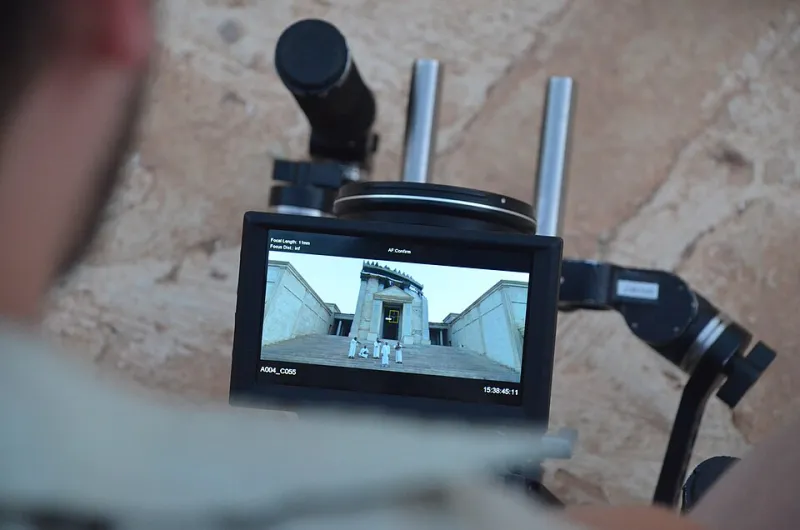
Not badly written, necessarily. Just redundant. Because in the hands of a skilled cinematographer and director, the camera has already told you everything you need to know about a character before they open their mouth. The words that follow are often just confirmation — or, in the best cases, deliberate contradiction of what the image already revealed.
This is the part of filmmaking that casual viewers absorb without realizing it. You walk out of a theater with a strong sense of who a character was, what drove them, what they were hiding — and if you try to explain why you felt that way, you'll probably reach for dialogue or plot points. But dig deeper and you'll find that the real work was done by the camera. By light. By the distance between bodies in a frame. By whether a character is centered or pushed to the edge of their own scene.
This isn't accidental. It's a language. And once you start reading it, movies open up in ways that are genuinely hard to describe.
Power Is About Space — Who Has It and Who Doesn't
One of the most immediate ways cinematography communicates character is through spatial dominance. Who fills the frame? Who gets pushed to the margins? In a scene with two characters, the camera's choice about whose perspective to adopt — whose eyeline we follow, whose face gets the close-up — is a statement about power dynamics that operates entirely below the level of dialogue.
Think about the early scenes in There Will Be Blood. Before Daniel Plainview says much of anything meaningful, the camera gives him enormous physical presence. He fills frames. He's shot from angles that make him loom. When other characters speak to him, we often see their faces — readable, exposed — while we get his back or his profile. He's already unreadable. Already in control. The cinematography is writing his character for us.
Contrast that with how Paul Dano's Eli Sunday is frequently framed — smaller, more centered in wide shots that expose him to scrutiny from all sides. The camera presents him as someone who wants to appear powerful while the lens quietly disagrees.
Light Plays Favorites — And It's Not Always the Hero
Lighting is arguably the most emotionally loaded tool in the cinematographer's kit. The way light falls on a face — where the shadows live, how much of a person is illuminated versus obscured — communicates inner life in ways that feel almost subconscious.
Roger Deakins, who has been doing things with light that border on supernatural for decades, uses this constantly. In No Country for Old Men, Anton Chigurh is almost never lit in a way that makes him fully legible. Shadows cut across his face at odd angles. He appears and disappears from light sources that don't quite make geographic sense. He's not just a dangerous man — the camera makes him feel like something that exists slightly outside normal physics. You feel that wrongness before you can articulate it.
Meanwhile, Tommy Lee Jones's Sheriff Bell is frequently shot in warm, natural light — open, readable, aging. The camera presents him as a man with nothing to hide, which is precisely his tragedy. He's too honest for the world he's been put in.
Camera Movement as Emotional State
Here's something directors don't always talk about explicitly but cinematographers understand deeply: the way a camera moves tells you how a character feels, even when the character is trying not to show it.
A locked-off, static camera observing a character who is supposed to be calm can create an unsettling sense of surveillance — the character may be composed, but the camera's stillness feels like held breath. Kubrick weaponized this constantly. The static shots in The Shining don't just observe Jack Torrance; they watch him with the patient, inhuman attention of something that already knows what he's going to do.
Conversely, a handheld camera following a character through a space lends them an immediacy and vulnerability that no amount of performance could fully replicate. The Dardenne brothers built entire careers on this principle. In Rosetta and Two Days, One Night, the camera doesn't just follow the protagonists — it seems to breathe with them, stumble when they stumble, push forward when they push forward. You understand these characters physically before you understand them intellectually.
Blocking as Biography
Where characters stand in relation to each other — and how they move through space — is a form of visual biography that unfolds in real time. Directors who think carefully about blocking can communicate relationship dynamics, power shifts, and emotional states without a single line of exposition.
In Marriage Story, Noah Baumbach and cinematographer Robbie Ryan use blocking to chart the collapse of a marriage with almost architectural precision. Early scenes have Adam Driver and Scarlett Johansson sharing frames comfortably, moving around each other with the easy familiarity of two people who know each other's rhythms. As the film progresses, watch how they begin to occupy opposite sides of the frame, how they stop moving into each other's space, how they begin to exist in the same shot as though separated by an invisible wall. The breakdown is visible before it's spoken.
The Close-Up as Confession
Finally, there's the close-up — the camera's most intimate and most revealing tool. A close-up is an act of trust between director and actor. It says: we're going to put your face under a microscope and see what's actually there.
The great close-ups in cinema work because they catch something true. Ingrid Bergman in Casablanca, caught between two men and two worlds, her face doing the work of a soliloquy. Tilda Swinton in We Need to Talk About Kevin, a character who has walled herself off so completely that the close-up becomes an act of excavation — the camera searching for the person buried underneath the guilt.
What makes these moments land isn't just the performance. It's the choice to get close. To say: look here. This is where the truth is. The camera is making an editorial decision about what matters, and in doing so, it's writing character in real time.
Watching Differently
Once you start noticing this stuff, it's hard to stop. And honestly, that's the whole point of what we do here at Flickerings. Every frame is a decision. Every lighting choice is an argument about who someone is. Every camera movement is a feeling made visible.
Dialogue is what characters say. Cinematography is what the movie knows about them.
And sometimes those two things are very different.