Happy Accidents: The Blunders, Breakdowns, and Brilliant Mistakes That Made Movie History
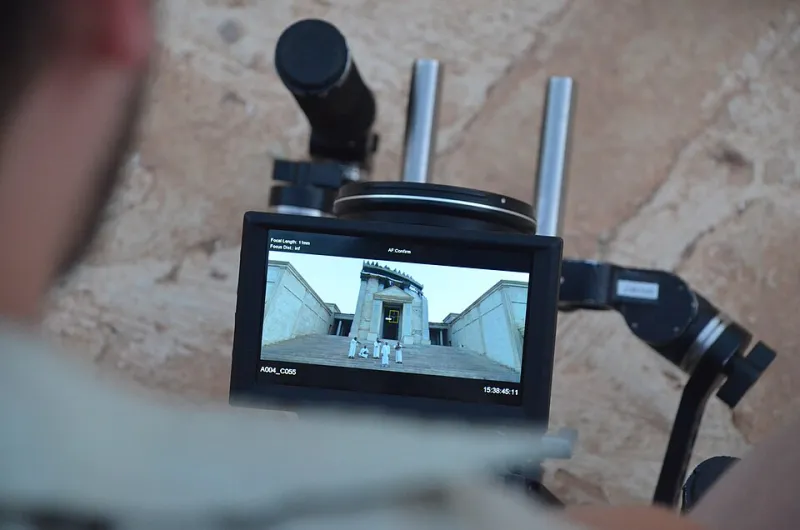
Photo: Saphabmr, CC BY-SA 4.0, via Wikimedia Commons
Let's be honest: the movie industry is obsessed with control. Storyboards, pre-visualization, shot lists, coverage plans — modern filmmaking has evolved into an elaborate machine designed to eliminate surprise. And yet, some of the most iconic moments in cinema history arrived not because of meticulous planning, but in spite of it. A mechanical failure here, an actor going off-script there, a lighting rig that wouldn't cooperate — and suddenly, you've got a scene people are still talking about fifty years later.
There's something almost philosophical about that. The unpredictable alchemy of filmmaking means that accidents don't just happen — sometimes, they improve.
The Shark That Couldn't Swim
Let's start with the most famous malfunction in movie history. When Steven Spielberg arrived in Martha's Vineyard in 1974 to shoot Jaws, he had a mechanical shark — nicknamed Bruce — that simply refused to work properly. Salt water corroded the hydraulics. The thing sank, malfunctioned, and generally behaved like a large, expensive piece of scrap metal.
For a lesser director, this might have been the end. For Spielberg, it became the film's greatest creative asset. Forced to hide the shark, he leaned into suggestion — the yellow barrels, the fin cutting through water, John Williams' two-note warning. The shark you don't see is infinitely more terrifying than the one you do, and audiences in 1975 proved it by essentially inventing the summer blockbuster in response.
Spielberg has acknowledged the irony many times since: the broken shark made Jaws better. The film's suspense mechanics — which influenced everything from Alien to modern horror — emerged directly from a production problem that had nothing to do with creative vision and everything to do with bad luck and saltwater corrosion.
A Glass Raised in Genuine Surprise
Daniel Craig's first outing as James Bond in Casino Royale (2006) contains one of the franchise's most charming moments — Bond ordering his famous martini, and the bartender asking whether he'd like it shaken or stirred. Craig's Bond, battered and exhausted, looks up and says: "Do I look like I give a damn?"
It's a perfect line. It redefines the character in one breath. And according to Craig and director Martin Campbell, it wasn't in the script. Craig improvised it during filming when he felt the original written response didn't capture the beaten-down version of Bond they were trying to establish.
The line stayed. It became one of the most-quoted Bond moments in the franchise's history, and it helped cement Craig's interpretation as a grittier, more emotionally raw 007. One unscripted sentence rewrote decades of martini mythology.
Kubrick's Happy Accident in the Overlook
Stanley Kubrick was one of cinema's great control freaks — the man who demanded dozens of takes and had sets built to exacting specifications. So it's particularly delicious that one of The Shining's most unsettling moments apparently emerged from technical chance.
The famous low-angle tracking shots of Danny riding his Big Wheel through the Overlook's corridors — those hypnotic, rhythmic sequences where the sound shifts between carpet and hardwood — were partly shaped by the Steadicam operator learning the technology in real time. The slightly imperfect, almost floating quality of those shots, the way they feel simultaneously smooth and wrong, contributed enormously to the film's dreamlike dread.
Kubrick, to his credit, recognized what he had and leaned into it. But the particular texture of those sequences — that quality that film students still try to reverse-engineer — emerged partly from a camera operator getting to grips with relatively new equipment on a live set.
Ledger's Card Trick and the Reaction That Couldn't Be Faked
Christopher Nolan's The Dark Knight contains one of modern cinema's most discussed scenes: the Joker's hospital visit with Harvey Dent, culminating in Heath Ledger's chilling, nurse-costumed walk away from the exploding building — detonator clicking unreliably while he waits, adjusting, nursing the moment with eerie patience.
That clicking, waiting, almost comedic pause? The building's detonation system malfunctioned during filming. It wasn't supposed to hesitate. Ledger, deep in character, simply stayed in it — kept clicking, kept walking, kept being the Joker — and the accidental delay created one of the scene's most memorable beats. The character's casual relationship with chaos, his amused patience with a world that doesn't cooperate, was amplified by a technical glitch that Ledger turned into performance gold.
Nolan kept every frame of it.
When DiCaprio Bled for His Art (Accidentally)
In Django Unchained, there's a moment during Calvin Candie's dinner table monologue where Leonardo DiCaprio's character slams his hand down and cuts it on a broken glass. The blood is real. DiCaprio kept going — stayed in character, used the injury, smeared the blood across Kerry Washington's face in a moment of improvised brutality that made the entire cast visibly shaken.
Quentin Tarantino, cameras rolling, kept shooting. The takes from that moment forward carry a charge that's almost impossible to manufacture deliberately, because everyone on screen is responding to something genuinely unexpected. DiCaprio received a standing ovation from the crew after that take.
It's one thing to direct an actor to be frightening. It's another when the actor bleeds on set and doesn't break, and suddenly the fear in everyone else's eyes is completely authentic.
What the Accidents Are Actually Teaching Us
These stories aren't just interesting trivia for film buffs to deploy at dinner parties. They point toward something genuinely important about the nature of creative work — and specifically about cinema, which sits at the intersection of industrial production and raw human performance.
No amount of pre-production can fully account for the moment an actor finds something unexpected in a scene, or a mechanical failure forces a director to solve a problem they didn't know they had. The best filmmakers aren't just the ones with the most meticulous plans. They're the ones who recognize a gift when chaos delivers it, who have the creative confidence to say: this broken thing is better than what we intended.
That instinct — to stay open, to adapt, to find the art in the accident — is maybe the most important skill a director can have. And it's the one that no storyboard can teach.
Some of cinema's most enduring frames weren't planned. They flickered into existence for a second, between a malfunction and a decision, and someone was paying close enough attention to catch them before they disappeared.