Dread on Delay: How Horror's Greatest Trick Happens Before You Ever See a Thing
There's a specific kind of suffering that only movies can inflict on you. It's not the jolt of a jump scare. It's not the queasy aftermath of watching something genuinely disturbing. It's that slow, suffocating stretch of time where you know something is coming and you cannot do a single thing about it. Your chest tightens. Your jaw locks. You might even lean slightly away from the screen, as though a few extra inches of couch cushion will somehow protect you.
That feeling — that agonizing, full-body anticipation — is the real engine of horror cinema. And the directors who understand it best are the ones who've figured out something counterintuitive: the longer they can keep the monster offscreen, the more terrifying the whole experience becomes.
The Space That Eats You Alive
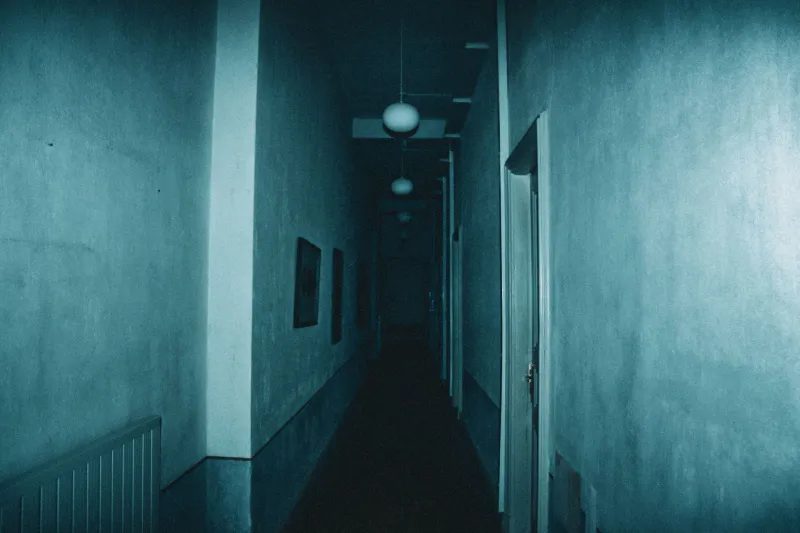
Ridley Scott understood this almost perfectly when he made Alien in 1979. The xenomorph is, objectively, a spectacular practical creation. But Scott was smart enough to know that showing it too often — too clearly — would deflate the entire film. Instead, he weaponized negative space. Corridors that stretch just a little too far. Vents that hum with ambiguous sound. Crew members who look just slightly too long at a corner of the room.
The monster barely appears in the first half of the film, and yet the dread is already unbearable. Why? Because Scott has trained your eyes to scan every shadow, every background detail, every poorly lit ceiling. He's turned you into a participant. You're not watching the crew search for the creature — you are searching for it, frame by frame, and that involuntary engagement is what makes the eventual reveal land so hard.
This is the negative space principle at work. What the camera doesn't show you becomes louder than anything it does.
Sound as a Setup Artist
If negative space is the visual half of anticipatory dread, sound design is the other half — and arguably the sneakier one.
Stanley Kubrick's The Shining is a masterclass in audio manipulation. The score by Wendy Carlos and Rachel Elkind doesn't just underscore scary moments; it creates a kind of ambient wrongness that coats every scene in the film, even the mundane ones. By the time something genuinely threatening happens, your nervous system has been marinating in unease for so long that the payoff hits with disproportionate force.
Consider the famous scene where Wendy discovers Jack's manuscript. Nothing jumps out at her. No one grabs her from behind. The horror is entirely informational — she reads the same sentence repeated thousands of times — and yet it's one of the most disturbing moments in the film. Kubrick earns that reaction not through shock, but through everything he's built before it. The sound design, the pacing, the deliberate wrongness of the Overlook's geometry — all of it has been quietly priming you to fall apart the moment something confirms your worst suspicions.
That confirmation is the detonator. The anticipation is the bomb.
Silence as the Loudest Warning
John Krasinski's A Quiet Place flips the sound design formula in a fascinating way. The entire premise — that making noise will get you killed — means the film trains you to treat silence not as safety, but as the most nerve-wracking condition possible. Silence means the creatures could be anywhere. Silence means one accidental sound ends everything.
The result is a movie where nothing happening is almost unbearable to sit through. Every quiet moment is loaded with potential catastrophe. Krasinski understands that your brain, denied information, will rush to fill the void with the worst possible scenarios. He doesn't need to show you the creatures constantly. He just needs to remind you, periodically, that they're out there — and then let your imagination do the rest.
There's a scene involving a bathtub and a nail that's become something of a cultural shorthand for sustained cinematic tension. The creature itself barely factors into why it works. What makes it almost unwatchable is the architecture of the setup: you understand the rules, you can see exactly what's about to go wrong, and you have absolutely no power to stop it. The dread isn't delivered to you. You build it yourself, in real time, from the materials the film provides.
Why Modern Horror Keeps Blinking First
For all the genuinely excellent horror being made right now, the genre has a persistent problem: impatience. The pressure to deliver scares quickly — to justify a budget, to satisfy an audience that's grown up on trailers that front-load every major scare — has pushed a lot of modern horror toward over-explanation and premature revelation.
When you show the monster too early, too clearly, too often, you hand the audience an exit ramp from their own imagination. Suddenly, the threat is finite. It has a shape, a size, a set of limitations. The unknown collapses into the known, and with it goes a significant portion of the fear.
This is the central tension in franchise horror especially. By the third or fourth installment, whatever originally terrified audiences has been so thoroughly catalogued — its weaknesses documented, its appearance familiar — that the films have to work twice as hard to generate even a fraction of the original dread. The mystery is gone, and mystery is load-bearing infrastructure in horror.
The Flicker Before the Frame
What all of this points to is something fundamental about how cinema interacts with human psychology. Film doesn't just show you things — it conditions you. It teaches you, scene by scene, what to expect, what to fear, what the rules are. And the best horror directors are essentially running a long con: they spend the first two acts patiently installing a set of anxieties inside you, and then the third act is just a matter of pulling the right triggers.
The jump scare, at its worst, is a cheap shortcut around all of that work. A loud noise and a sudden image will make almost anyone flinch, regardless of whether the film has done anything to earn it. But the earned scare — the one that arrives after twenty minutes of tightening dread — hits differently. It hits in your chest, in your shoulders, in the back of your throat. It hits in all the places where you've been quietly bracing for it.
That's the flicker that matters. Not the moment the monster fills the frame, but the long, dark stretch of anticipation before it does — the space where the real horror has been living all along, patient and invisible, waiting for you to catch up.