Four Wheels, More Screen Time Than the Lead: Hollywood's Longest-Running Stars Don't Have Agents
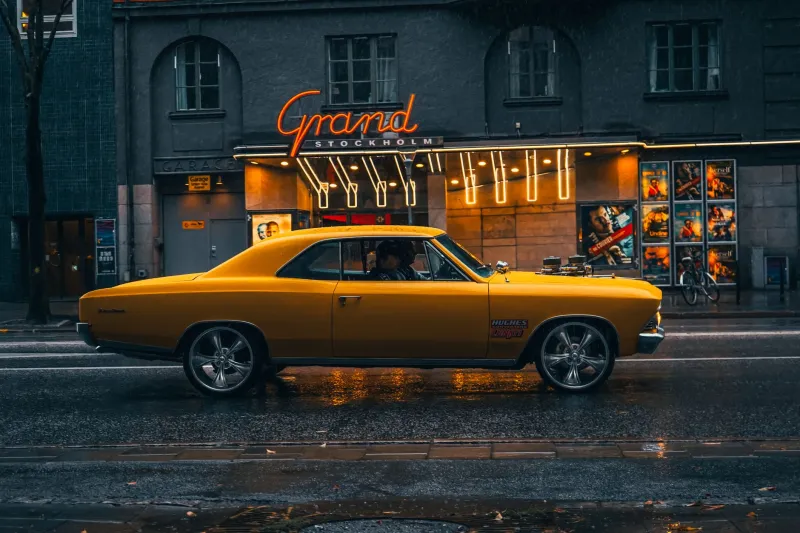
Here's a trivia question that ruins dinner parties: name the actor who appeared in all three Back to the Future films, got top billing in the marketing, and is still pulling crowds at fan conventions decades later. If you said Michael J. Fox, you're right — but only technically. The stainless-steel answer parked next to him in every poster did just as much work, and unlike Fox, it never needed a stunt double.
Movie cars occupy a strange tier of fame. They can't deliver a line, but they can end a scene with a rumble. They don't have faces, but every American over the age of ten can identify a 1981 DeLorean from a silhouette in fog. That's not luck. That's craft.
The Casting Call You Never See
Directors talk about casting cars the way they talk about casting actors, because the process isn't that different. A vehicle brings a pre-loaded personality to set — the way a grizzled character actor walks in with fifty years of baggage. A 1970 Dodge Charger rolls onto a lot already radiating menace. That's not the paint job. That's decades of cultural homework the audience did for free.
George Miller understood this better than anyone. The Pursuit Special in Mad Max isn't just a Ford Falcon XB — it's a supercharged black fist of Australian muscle that communicates "this man has nothing left to lose" before Max says a word. No dialogue required. The car is the character arc.
American filmmakers learned to lean on this shorthand hard, for obvious reasons. We're a country that named a generation after a car (the Baby Boom and the Ford Mustang are practically siblings). When a director points a camera at an automobile, they're not showing you transportation. They're showing you a value system.
How You Shoot a Co-Star That Can't Blink
Giving a machine screen presence requires specific grammar. Watch how films frame their iconic vehicles and patterns emerge fast.
The low-angle introduction. The car gets the villain entrance: camera near the pavement, engine filling the frame, headlights blazing into the lens like a stare. Christine uses this so relentlessly that a 1958 Plymouth Fury becomes a genuine supernatural threat. John Carpenter shoots that car like it's auditioning for a horror role, because it is.
The detail insert. A hand on a gearshift. Chrome catching sunlight. A speedometer needle climbing. These close-ups are the cinematic equivalent of a character's nervous tic — small physical details that build intimacy. Bullitt spends more time on Steve McQueen's eyes in the rearview mirror than on dialogue, and the Mustang becomes an extension of his pulse.
The sound design signature. Close your eyes and you can still hear the difference between the General Lee's horn, the Batmobile's turbine whine, and the DeLorean's door thunk. Sound designers treat engines like voice actors. The General Lee doesn't just jump — it announces itself, that Dixie horn doing the work a theme song usually handles.
The Cars That Refused to Die
What's genuinely odd is the survivorship. Actors age, retire, pass away. The cars just keep getting recast.
Eleanor — the Mustang from Gone in 60 Seconds — has now been "played" across two separate productions, a 1974 original and the 2000 remake, making her one of the only vehicles with a franchise résumé. The 1970 Charger that dominated The Fast and the Furious got a funeral scene, a resurrection, and more sequels than most leading men dream of. Vin Diesel's Dominic Toretto is, if we're honest, the second-most important performance in his own movies.
There's an economics angle too. A-list salaries balloon; a picture car costs a rental fee and an insurance policy. But the deeper reason is emotional: audiences will forgive a recast human before they'll forgive a recatted icon. Try telling a Smokey and the Bandit fan that the Trans Am was interchangeable with any black Firebird. Go ahead. We'll wait.
The Memory Lives in the Machine
There's a reason the Smithsonian displays movie cars and not, say, the coffee mugs from the craft services table. The automobile is America's most honest storytelling device — it's where we had our first kisses, our worst commutes, our loudest arguments and best singalongs. When a film gets a car right, it's not borrowing cool. It's borrowing our own memories.
So the next time a car "acts" circles above a marquee performance, give it some credit. It hit its mark, held its angle, and never once asked for a trailer. Two seconds of screen time, fifty years of cultural residency. That's not a prop.
That's a star.