Lights Out: Why Flickering, Shadows, and Darkness Are Cinema's Most Underrated Mind Games

Photo by Photo by CHRSNDRSN on Unsplash on Unsplash
Before a single jump scare lands, before the villain shows their face, the light in a scene has already done most of the heavy lifting. Filmmakers have long understood that intermittent light — a guttering candle, a dying fluorescent tube, a strobe cutting through smoke — doesn't just set a mood. It rewires how your nervous system processes what you're watching.
There's something almost unfair about it, honestly. Directors who know what they're doing can make you feel dread without showing you a single scary thing. They just mess with the light.
Your Brain Hates Not Knowing What Comes Next
Here's the neurological backstory, and it's worth knowing because it makes rewatching these scenes even more interesting. Human brains are prediction machines. Every fraction of a second, your visual cortex is making micro-bets about what the next frame will look like. Stable, consistent light lets those predictions run smoothly. Your brain stays calm. You relax into the story.
But flickering light? That's a wrench in the gears. Each interruption forces your brain to recalibrate — to ask, what was in that gap? That gap is where filmmakers plant anxiety. Not in what they show you, but in what they briefly, rhythmically deny you. The darkness between flickers becomes a canvas for your imagination, and your imagination, as any horror director will tell you, is the most reliable monster in the business.
This is why strobing effects have been used as a genuine psychological tool far beyond cinema — in interrogation rooms, in certain therapeutic contexts, even in military disorientation tactics. The flicker isn't just aesthetic. It's physiological.
The Slow Burn: Candlelight and the Horror of Almost Seeing
Candlelit cinematography is one of the oldest tricks in the book, and it still works because it exploits the same vulnerability. Think about the opening sequences in Hereditary — Ari Aster and cinematographer Pawel Pogorzelski didn't lean on strobes, but they weaponized low, wavering light sources to keep the frame in a constant state of soft instability. Shadows breathe in that film. They shift slightly between cuts. Your eye keeps chasing the edges of the frame, trying to confirm what's lurking just outside the light's reach.
Stanley Kubrick understood this intuitively. Barry Lyndon is famous for being shot by actual candlelight using a NASA-developed lens, and while the film isn't horror, those scenes carry an unease that's hard to name. The flickering is so authentic, so analog, that it triggers something primal — a memory your body holds from centuries before electricity, when darkness genuinely meant danger.
Candlelight flickers at roughly 1 to 16 Hz depending on air movement. That range overlaps with frequencies that can induce mild altered states in some viewers — not full hallucination, but a subtle loosening of the boundary between what's real and what's imagined. Filmmakers don't need to know the science to use it. They've been stumbling onto it through instinct for over a century.
Neon and Fluorescent: The Modern Monster
If candlelight is the gothic version of this trick, dying neon signs and malfunctioning fluorescent lights are its urban, contemporary cousin. And in a lot of ways, they're even more effective for modern audiences because they're tied to recognizable spaces — parking garages, hospital corridors, cheap motels, late-night convenience stores.
Denis Villeneuve's Prisoners uses flickering and inconsistent artificial light throughout to create a world that feels perpetually on the verge of failing. It's not just atmosphere — it's a visual metaphor for the moral and psychological collapse happening to the characters. The lights in that film don't work right because nothing works right.
Jeremy Saulnier's Blue Ruin and Green Room both deploy malfunctioning artificial light as a way of signaling that a space has become hostile. When the lights in Green Room start cutting in and out, your body already knows something terrible is about to happen before the script confirms it. The cinematography is doing the narrative work.
Then there's the strobe itself — used most aggressively in films like Enter the Void and Climax, both by Gaspar Noé, a director who practically has a PhD in using light as a form of controlled assault. Noé's strobing sequences are deliberately overwhelming, designed to make you feel what his characters feel: disorientation, loss of control, the terrifying collapse of stable perception. It's not subtle. But it's undeniably effective, and it's grounded in the same neurological principle — interrupt the light, interrupt the viewer's sense of safety.
Shadow Play: When Darkness Is the Character
Some directors skip the flicker entirely and go straight to strategic shadow — using darkness not as an absence but as a presence. F.W. Murnau was doing this in Nosferatu back in 1922, letting Count Orlok's shadow climb a staircase and spread across a door while the actual figure stayed off-frame. The shadow moved. It had intention. And because it was only a shadow — undefined, shape-shifting — it was more frightening than any direct shot of the monster could have been.
James Wan brought this sensibility into contemporary horror with the Conjuring series. His cinematographer, John R. Leonetti, has talked about the deliberate choice to leave portions of the frame in deep shadow, forcing the audience to stare into dark corners and do the director's job for him. When you're actively scanning the darkness in a movie frame, you're no longer a passive viewer. You're a participant. And that participation makes the eventual reveal — or sometimes the deliberate non-reveal — land so much harder.
The Flicker Is the Point
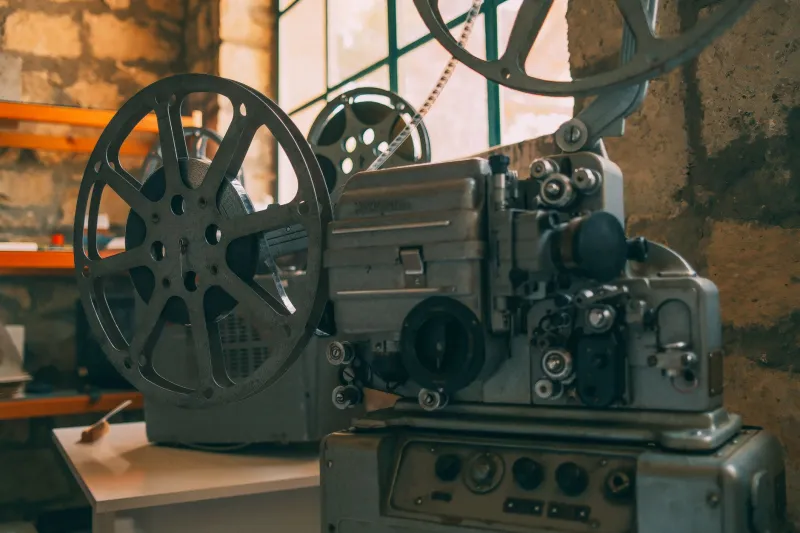
It's worth stepping back and noting something that feels very on-brand for a site called Flickerings: the word flicker is literally baked into the history of cinema itself. Early film projection created an unavoidable strobing effect — the persistence of vision phenomenon that makes still images appear to move is, at its core, a trick played on the brain using interrupted light. Every movie you've ever watched is, technically, a flicker.
The directors who use flickering light as a psychological tool aren't doing something foreign to cinema. They're reaching back to the medium's most fundamental property and making it visible again — making you feel the flicker instead of letting your brain smooth it over.
That's the real trick. The best uses of strobing, shadow play, and dying light sources in film don't feel like technique. They feel like truth. Like the movie is momentarily losing its grip on its own reality, and taking you with it.
Which is, when you think about it, exactly what great horror has always done.