The Note Before the Feeling: When a Score Shows Up Too Soon
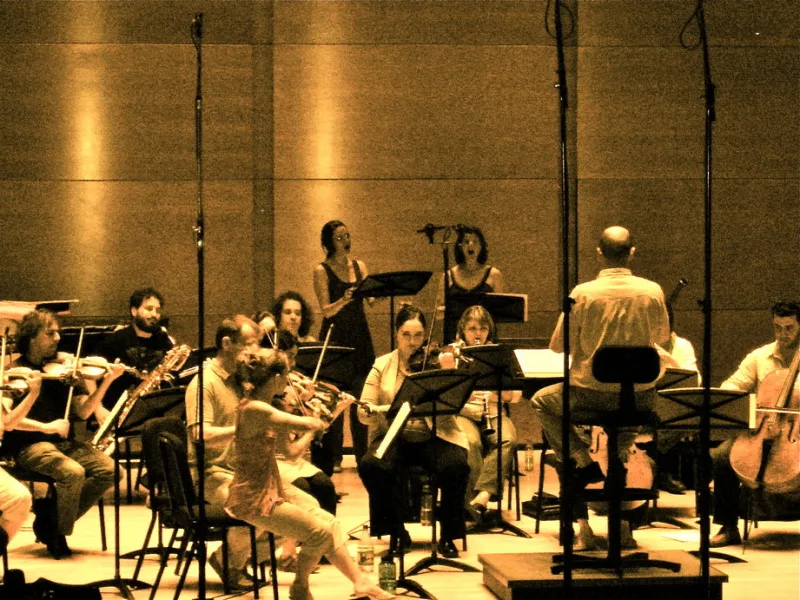
Photo: Kati Agocs, CC BY-SA 3.0, via Wikimedia Commons
There's a moment in every scoring session where somebody in the room asks the question that has ended friendships: does the music start here, or one beat later?
It sounds like a technicality. It isn't. The first note of a cue is the single most opinionated thing a film score does. It tells an audience what to feel before they've had a chance to feel it on their own — and depending on where you drop it, that's either an act of generosity or an act of theft.
The First Note Is a Promise
When strings creep in under a conversation, the audience starts bracing. When a piano enters on a wide shot of a highway, the audience starts grieving. The music isn't describing the moment. It's describing the moment that's about to arrive.
That's an enormous amount of power to hand a composer, and it's why the timing gets fought over so hard. A cue that starts two seconds early can turn a scene of two people making dinner into a scene of two people making dinner while something terrible waits in the driveway. Same footage. Same performances. Completely different movie.
The Case for Waiting
Some of the most confident filmmaking of the last few decades has been defined by composers and directors agreeing to do less, later.
No Country for Old Men is practically a masterclass in refusal. Carter Burwell's contributions are sparse enough that long stretches of the film run on nothing but wind, footsteps, and the sound of a bolt gun. The result is a movie that feels like it's happening to you rather than being narrated at you. When music finally does show up, it lands like a hand on your shoulder.
Christopher Nolan and Hans Zimmer built Dunkirk around the opposite idea — a score that functions less as emotion and more as architecture. The ticking that runs through the film wasn't a composer's flourish; it was written into the approach from the start, a clock the audience can hear but the characters can't. Nolan has said plainly that he doesn't want music telling people how to feel. He wants it telling them how much time is left.
And then there's Oppenheimer, where Ludwig Göransson's violin line doesn't so much underscore a scene as teach you how to watch the whole film — a tempo that keeps doubling until the audience understands, in their nervous system, what acceleration feels like. That's a cue arriving early on purpose, and it works because it's building grammar instead of pushing buttons.
When the Music Shows Up Wearing the Villain's Coat
The failure mode is easy to spot and almost impossible to un-see once you've noticed it. A character walks into a room smiling, and the score slides into a low, queasy drone. Congratulations — the movie just told you the smile is fake. You didn't get to be suspicious. You were informed.
This is the accidental spoiler, and it's everywhere in mid-budget thrillers and streaming genre pictures. A twist works because the audience is allowed to believe the wrong thing for a while. A score that leans on the wrongness too early has effectively handed out the answer key in the lobby.
Horror is the worst offender and the biggest victim, because dread is the one thing that dies when it's announced. The best scary movies treat music like a smoke alarm they're trying to hide behind the couch. Herrmann's strings in Psycho work precisely because they don't warn you — they ambush you, at the exact moment the knife arrives. That's a cue that arrives too late by any conventional measure, and it's the reason the scene has outlived everyone who made it.
Silence Is a Cue Too
Here's the part that composers learn to say out loud in meetings: silence isn't the absence of a score. It's a decision with a start time and an end time, exactly like a cue.
A composer who pulls music out of a scene is doing the same job as one who writes forty bars — they're just doing it with subtraction. The trouble is that subtraction doesn't show up in a temp mix. A director falls in love with a temporary track during editing, the scene gets cut and recut against that borrowed music, and by the time the real composer shows up, the scene has been physically shaped to fit a piece of music that can't legally stay. That's how you get a final score that sounds like a polite imitation of something the audience will never hear.
The whole thing is a hostage negotiation between two people who want the same outcome. Directors want to guarantee the audience feels the thing. Composers want the audience to be trusted to feel the thing. Neither is wrong, and the argument is the reason good movies sound the way they do.
A Small Practical Note for 2026
Streaming has made this fight weirder. Mixes get mastered for phone speakers and soundbars, which means subtle cues vanish and loud cues get louder. A delicate late entry that worked beautifully in a theater can disappear entirely in a living room — and so the pressure creeps back toward starting earlier, hitting harder, making sure nobody misses the point.
That's a shame, because the note that arrives a half-second late is doing something no streaming algorithm can measure. It's giving you a beat to decide how you feel about a moment before anyone tells you.
Next time a scene lands and you can't quite say why — check whether the music waited. Odds are it did.