Your Brain on Fast Cuts: Why Modern Editing Is Rewiring the Way We Watch Movies
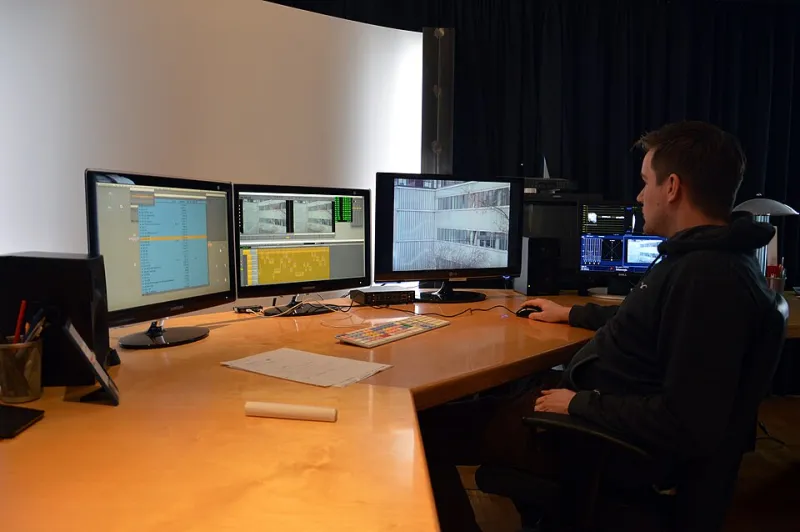
Photo: Klaus Eichler, CC BY-SA 3.0 de, via Wikimedia Commons
There's a moment in Everything Everywhere All at Once where the Daniels — directors Daniel Kwan and Daniel Scheinert — throw roughly a dozen visual ideas at you in under ten seconds. Googly eyes. A raccoon. Existential dread. A hot dog finger. Your rational mind barely has time to register what's happening before the next image arrives. And yet, somehow, you feel everything.
That's not an accident. That's neuroscience dressed up as filmmaking.
Rapid montage and hyper-fast editing have become defining signatures of contemporary cinema, showing up everywhere from superhero blockbusters to intimate indie dramas. Critics have argued for years that this style is a symptom of diminishing attention spans — a concession to audiences who've been conditioned by TikTok and YouTube Shorts. But that framing sells the technique short. What's actually happening inside your skull when those frames flicker by is a lot more interesting than simple distraction management.
The Brain Loves a Pattern — Until It Doesn't
Here's the basic neurological setup: your brain is a prediction machine. Every waking second, it's generating forecasts about what comes next — in conversation, in movement, in visual experience. When something disrupts that prediction, your brain releases a small hit of dopamine. It's the same chemical reward loop that makes plot twists satisfying and jump scares terrifying.
Fast editing exploits this constantly. Each cut is a micro-disruption. Each new image is a tiny surprise your brain has to process and integrate. When cuts arrive in rapid succession, your brain doesn't shut down — it actually ramps up, working overtime to stitch coherent meaning out of fragmented visual information. The result is heightened alertness, emotional activation, and a sense of urgency that slower editing simply can't manufacture at the same speed.
Neuroscientists call this process "predictive coding," and filmmakers — whether they know the terminology or not — have been intuitively tapping into it for decades. What's changed is the intensity and intentionality behind the approach.
Maverick and the Art of Controlled Chaos
Consider Top Gun: Maverick. Director Joseph Kosinski and editor Eddie Hamilton built the film's flight sequences around an almost overwhelming barrage of cockpit angles, aerial shots, and instrument close-ups. Traditional filmmaking wisdom would tell you to give audiences spatial orientation — let them know where they are before you move the camera. Kosinski largely ignores that rule during the film's most intense sequences.
The effect isn't confusion. It's immersion. You don't know exactly where Maverick's jet is relative to the canyon walls, and that disorientation is the point. Your nervous system responds to the visual chaos the way it would respond to actual danger — elevated heart rate, tensed muscles, breath held without realizing it. The editing isn't just describing a dangerous situation. It's making your body feel one.
This is a meaningful evolution from the editing philosophy of, say, classic Hollywood action cinema. In a 1980s action film, rapid cuts were often used to cover stunt work or hide practical limitations. In Maverick, the cuts are the experience. They're not concealing anything — they're constructing something.
When Fragmentation Becomes Emotional Language
What makes the Daniels' approach in Everything Everywhere so remarkable is how they weaponize visual fragmentation not for action, but for feeling. The film's editing — handled by Paul Rogers — shifts tempo constantly and deliberately. Quiet domestic scenes breathe with long, unhurried takes. Multiverse chaos arrives in machine-gun bursts. The contrast trains your nervous system to associate editing speed with emotional register.
By the film's climax, you've been conditioned. When the cuts slow down, you feel relief. When they accelerate, you brace for impact. The editing has become a language, and you've learned to read it without realizing you were being taught.
This is sophisticated filmmaking operating on a largely subconscious level — and it represents a genuine evolution in how directors think about pacing as an emotional tool rather than simply a narrative one.
The Attention Span Debate Is the Wrong Conversation
It's tempting to frame all of this as cinema capitulating to a generation raised on short-form content. That argument assumes rapid editing is a lesser form — a compromise. But the evidence suggests otherwise.
Audiences aren't responding to fast cuts despite complexity. They're responding to fast cuts because they create complexity. The fragmentation asks something of the viewer. It demands active cognitive participation, the filling-in of gaps, the construction of meaning from incomplete information. That's not passive entertainment. That's engagement.
The directors doing this best — the Daniels, Kosinski, Edgar Wright, whose Baby Driver essentially built a film around the rhythm of its editing — aren't dumbing things down. They're raising the cognitive stakes, trusting audiences to keep up, and rewarding them when they do.
What This Means for Where Cinema Is Headed
The broader implication here is genuinely exciting for anyone who loves movies. If editing is evolving into a primary emotional language — not just a structural tool — then we're entering a period where the rhythm of a film carries as much meaning as its dialogue or its cinematography. That's new territory, and it opens up creative possibilities that traditional filmmaking grammar couldn't accommodate.
It also means that the conversation around "good" editing needs to expand. Coherence and spatial clarity are still valuable. But so is deliberate disorientation. So is the emotional whiplash of a perfectly timed rapid sequence. So is the way a sudden burst of fast cuts can make your heart race before your conscious mind knows why.
Every frame tells a story, sure. But sometimes the story is told in the space between frames — in the flicker itself, in the gap your brain rushes to fill. That's the real magic trick modern cinema is pulling off, and we're only just beginning to understand how deep it goes.